Barz antifog goggles
Wearing Barz helps my eye comfort a lot, and my eyes look good to my ophthalmologist.
My activities are no longer limited by my Sjogren's Syndrome eye dryness.
I can comfortably bicycle, take airplanes, sit under ceiling fans, drive with the defroster on.
I can relax outside on windy days. I can take the laundry out of the dryer without flinching.
The manufacturing process for the antifog coating is still somewhat experimental, and there
are some difference from batch to batch.
I actually wound up having to use the perforated gaskets
to get fog free results with some January 1999 vintage lenses. With later lenses,
I have gotten two months' good antifog results.
One drawback is that in very cold weather the lenses will ice up and become opaque.
It has to be well below freezing, or else very windy, for this to happen.
Details
How do they feel?
My eyes really enjoy the near-100% humidity environment provided by the goggles. They feel
moister, more comfortable, and less frequently in need of artificial tears.
It only took about a week of wearing the goggles to become addicted to them.
Now, going without the goggles feels masochistic; it gives me a burning
feeling that I had not previously noticed. The goggles have raised my standard of eye comfort.
Fitting to the face
It took some work to get the fit of the goggles right; I had to
experiment with different size nosebridges, and rotate the gaskets around to
fit my face more closely. That got me to be about 95% happy with the fit.
By removing the standard nosebridge and replacing it with one that I
improvised myself, I have improved the fit, and am now about 98% happy with it.
The new fit gives me slightly better peripheral vision, better airtightness, and
much better comfort; no more red lines from my nose being pinched.
The improvised nosebridge is made from a nylon "cable tie" bought at
an electronics supply house (Radio Shack). A piece of strong string or fishing line might work as well.
How do they look?
Barz on a shelf.
Crystal frames on a person.
Tortoise frames on a person.
Blue frames on a person.
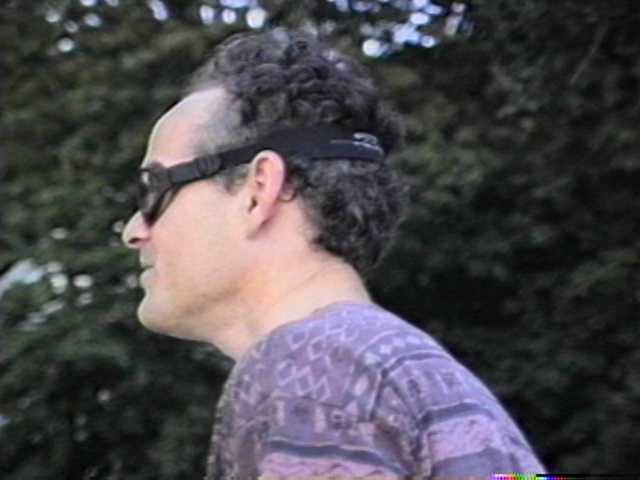
Tortoise frames, side view.
Just how good is your vision with these on?
Well I don't have actual vision test results to report. Subjectively though,
most of the time, vision is almost completely unimpaired. There is a
slick-looking film of water on the inside of the lens that introduces
minimal distortion. For example, night driving vision is not
significantly impaired. The slick film is just barely visible
from the outside of the lens
(e.g. by somebody you're talking to, if they look closely) but from the inside
you can't see it.
From time to time, and for reasons I don't yet understand,
drops of moisture
will form after an hour or two, toward the periphery of the lens.
If these begin to distort vision, they
can be cleared by wetting the lenses with distilled water,
and will stay clear for an hour or two afterward.
Peripheral vision
There is a minor loss of peripheral vision while wearing Barz. I guess it could be more loss or
less loss for people with differently shaped faces. The two times I notice it are in
social situations, and when about to step out and cross a street. At both of those times, my
neck gets a little more exercise (swiveling to look) than it would if my eyes were uncovered.
The light-colored Barz (crystal and pearl) come with a translucent gasket.
In good lighting conditions, you can detect light and motion
through the translucent gaskets -- for example, you can tell that somebody just walked up
next to you from behind, even though you can't tell who it is until you turn to look.
If you prefer a dark-colored frame, you could probably arrange to get dark frames with translucent
gaskets.
Fogging during sweaty exercise
Unlike other so-called antifog goggles, these goggles don't fog up during
sweaty exertion. (Although I have had some fogging with older lenses,
easily resolved by wetting the lenses). I have ridden a bike without fogging
for 7 hours at a stretch, occasionally
lifting the bottom of the goggle to allow accumulated pools of sweat to pour
out from the eyecup. These lenses thrive on having near-100% humidity behind them.
Any ophthalmologically observable change in eye condition?
I visited my ophthalmologist just before donning the goggles,
and again, after 11 weeks of wearing them.
His comment after my 11 weeks of goggle wearing was that "your eyes look better
than I've ever seen them", with a good quality tear film.
While this is obviously not a conclusive trial, it is an encouraging result
for me personally. It means at the very least that doing what's comfortable
for my eyes has not been harming them.
Any grossly observable change in eye condition?
Nothing definitive. Subjective hints that tear film quality is better, and
subjective hints that chronic blepharitis is better.
Changes in eye care routine
I now use artificial tears less frequently.
Also, because evaporation is radically reduced, it makes sense that there would be
less tendency for the osmolarity ("saltiness") of the tear film to climb.
There is some evidence that
elevated tear film osmolarity
damages the epithelium of the eye over the years --
so, reducing evaporation could be promoting the longterm health of the eyes.
Prescription lenses
Within a limited range of strength, prescription lenses can be ordered with the antifog coating.
There's an added cost of US$95. Note that it currently takes several weeks
to first get the lenses ground, and then get them scheduled into a batch for the factory treatment
with the antifog coating.
Obviously, with the prescription lenses, the durability of the antifog coating becomes
more important, because it becomes more expensive to replace the lenses.
Tips on using the goggles
The following works for me:
- Somewhat counterintuitively, these treated lenses remain fogfree only if they're kept
moist enough! That means that I:
- Start the day off by wetting the lenses with distilled water.
To do this, I hold them with eyecups facing up, put distilled water in each eyecup, let soak for 15 seconds.
Then I tip the water out, give the goggles a shake dry, and put them on my face.
Any water spots will soon smooth out. I don't let the water get in my eyes; even the cleanest looking
water can carry microorganisms, including nasty ones such as amoeba castellanii.
- I leave the goggles on my face at all times to keep the moisture in.
If I remove the goggles for more than 30 seconds or so, I usually have to rewet them.
(To put in artificial tears, I can slide the goggles up onto my forehead and put the
tears into my eyes. This usually does not require rewetting the goggles because it's
such a quick operation and the goggles stay sealed against my forehead.)
- Normally, the moisture from my eyes and my sweat inside the goggles should keep the
lenses moist enough to be fogfree, but at times I do need to rewet them.
So, when I leave the house, I pocket a 4 ounce squeeze bottle of distilled water for rewetting the lenses.
- When I do amateur optician work on my goggles (replacing the nosebridge, rotating
the gaskets, replacing the lenses, etc.) I am sure to wear disposable vinyl gloves
to avoid smudging the lenses
during these operations.
- I have been taking the precaution of not doing amateur optician work on my goggles
when the lenses are moist. I let the lens coating dry out before doing such
operations as replacing lenses. Is this precaution necessary? I am not sure.
- I find that I attract some extra attention on the street with my fine-looking goggles.
In general, people will work hard to make eye contact with me. Children are eager for another look.
One teen in the grocery store stared at me for awhile
and eventually said, "Wow, safety first, man!". I am frequently asked if I rode my motorcycle over,
or if I'm flying a biplane.
Tips on what not to do
- I don't touch the lenses inside or out; finger oils will smudge the lenses and will
deteriorate the antifog properties.
- I don't wet the lenses with oily or waxy water.
- I don't get suntan lotion onto my lenses.
- I don't try to clean the lenses with alcohol, which is said to remove the antifog coating.
- I don't use dishwashing liquid to clean lenses; I have wrecked them that way.
- I don't use the perforated gaskets that come as a second set of gaskets with standard Barz; I use the unperforated ones.
The perforated gaskets
are an older technology that predates the antifog lenses. When I tried
the perforated gaskets, the antifog lens couldn't stay wet enough to stay clear.
Tried and True goggle cleaning and hygiene methods
These techniques have worked reasonably well for me for a period of months.
The best thing to do is not get the lenses dirty,
and especially don't get them oily.
Before taking the goggles off for the night, I rinse the lenses with a couple of squirts from my distilled water bottle.
The lens coating becomes, over time, a little bit temperamental, for reasons I don't understand. This is
not true of a brand new lens, but after a week's wear,
the antifog coating will become less effective, and wetting the lenses will be
required more often, especially first thing in the morning.
There is a fix for this: I put them in a clean drinking glass and add distilled water to cover them, then let
them soak overnight. After an overnight soak,
the lenses behave better -- they don't need multiple wettings to get them going in the morning
(after all, they've been wet all night). Two nights of the treatment is even better.
Then after a month or so, they may need the overnight soak again. Or, they might have to be replaced
after a month or two.
I have some concern about soaking because I know that microbes can grow happily in distilled water. Goggles
on my face 18 hours a day eventually collect organic matter in the nooks and crannies,
that can presumably be a growth medium for microbes. So,
I don't soak for days on end. And, I don't let the water from the goggles get into my eyes!
Practically speaking, at this point I am glad to have multiple pairs of Barz, so that
if a pair of lenses ceases to defog properly, I can wear the backup pair
while soaking the main pair to rejuvenate them.
There is of course also the option of going without the goggles, like I used to
in the old days -- but that option has become quite unappealing.
Can I try these goggles?
You can order the goggles from http://www.murrays.com
Statement of Financial Interest
Nobody associated with Dry.Org has any financial interest in Barz, Murrays, or any of their
suppliers. Dry.Org is however unabashedly eager to see a commercial market develop for truly fogproof sealed
eyewear, so that dry-eyed people can house their eyes in near-100% humidity for comfort and
longterm eye health, while living active lives.
[Dry.Org Home]
[Contact Dry.Org]